Make a shared table easy to reclaim after work
The laptop and open notebook in this photograph sit on a generous wood table surrounded by upholstered chairs. Remove the work items and the surface still belongs to a home. That adaptability is the point: an office doesn't always need an office-looking desk.
For occasional remote work, a dining-style table can be a sensible choice because it supports other activities when the laptop closes. Limit the daily equipment to a portable kit—a laptop, notebook, charger, and perhaps a small task accessory—and give the kit one place to go afterward. The end-of-day reset is as important to the room's appearance as the table itself.
I would not choose this arrangement for someone who needs a permanent dual-monitor workstation or specialized equipment. The daily setup and clear-away time would defeat the flexibility. The questions about desk shape, construction, and alternatives are covered more closely in Room & Matter's Home Office Desk Ideas.

Test the screen against daylight before placing the desk
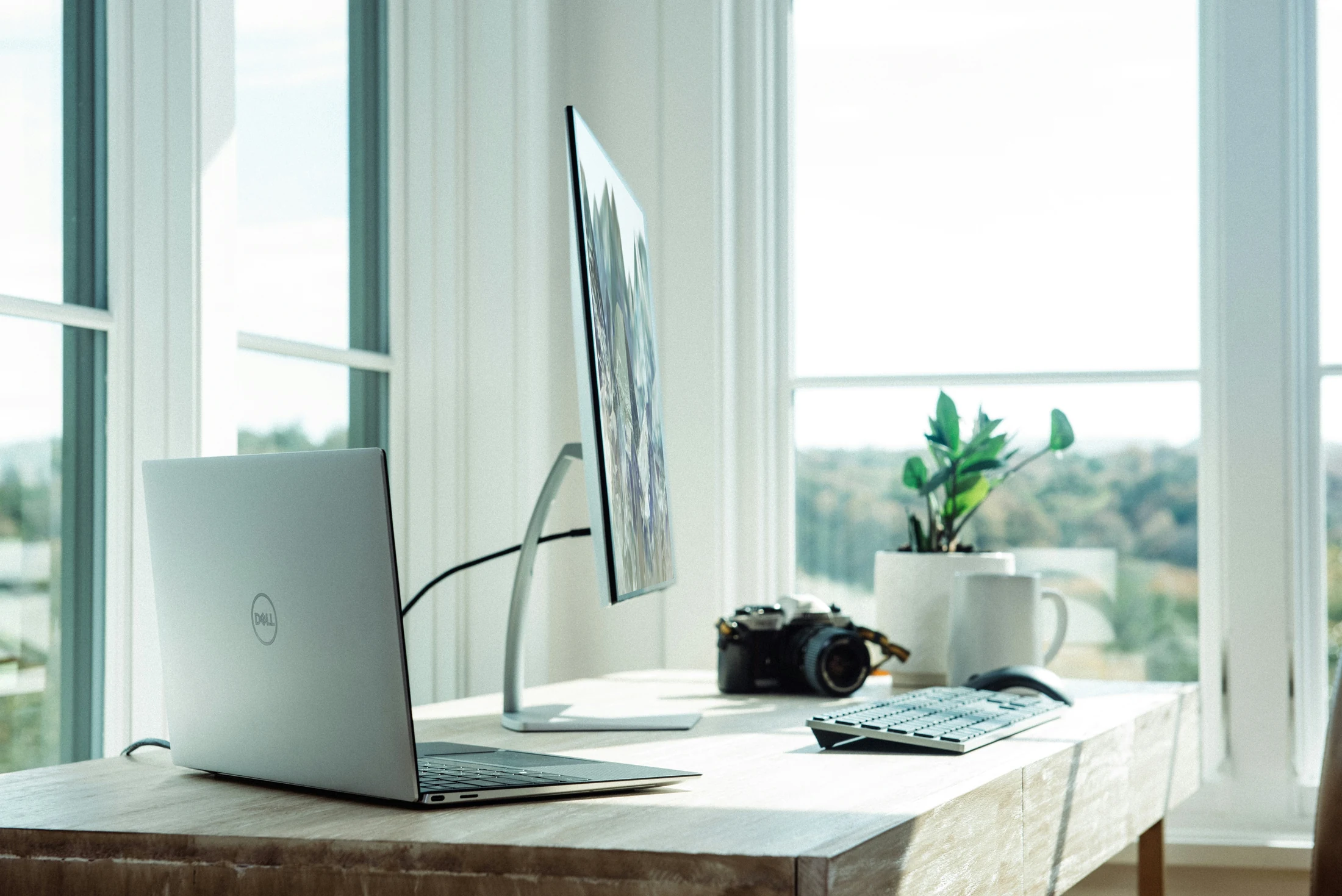
Tall windows are one of the attractive features of this workspace, but the monitor and laptop sit close enough to the glass that reflections could matter. A bright view is not the same thing as a good view of the screen. The position that photographs best at noon may be awkward for a late-afternoon work session.
Before settling on the desk layout, sit where you will actually work at the times you usually work. Put a bright and a dark page on the screen, look for reflected windows or overhead lights, and adjust the angle of the monitor or the position of the desk. Window coverings help when the sun changes direction. OSHA's workstation guidance suggests placing the monitor at a right angle to a window and using blinds or drapes to cut glare; the right arrangement still depends on your room and equipment.
You don't have to give up the daylight. Often a quarter turn of the desk, or a sheer panel on the brightest window, keeps the light and loses the glare. Detailed lamp and bulb comparisons deserve their own lighting guide; the first decision in this room is the layout.
Make one wall do the work of storage
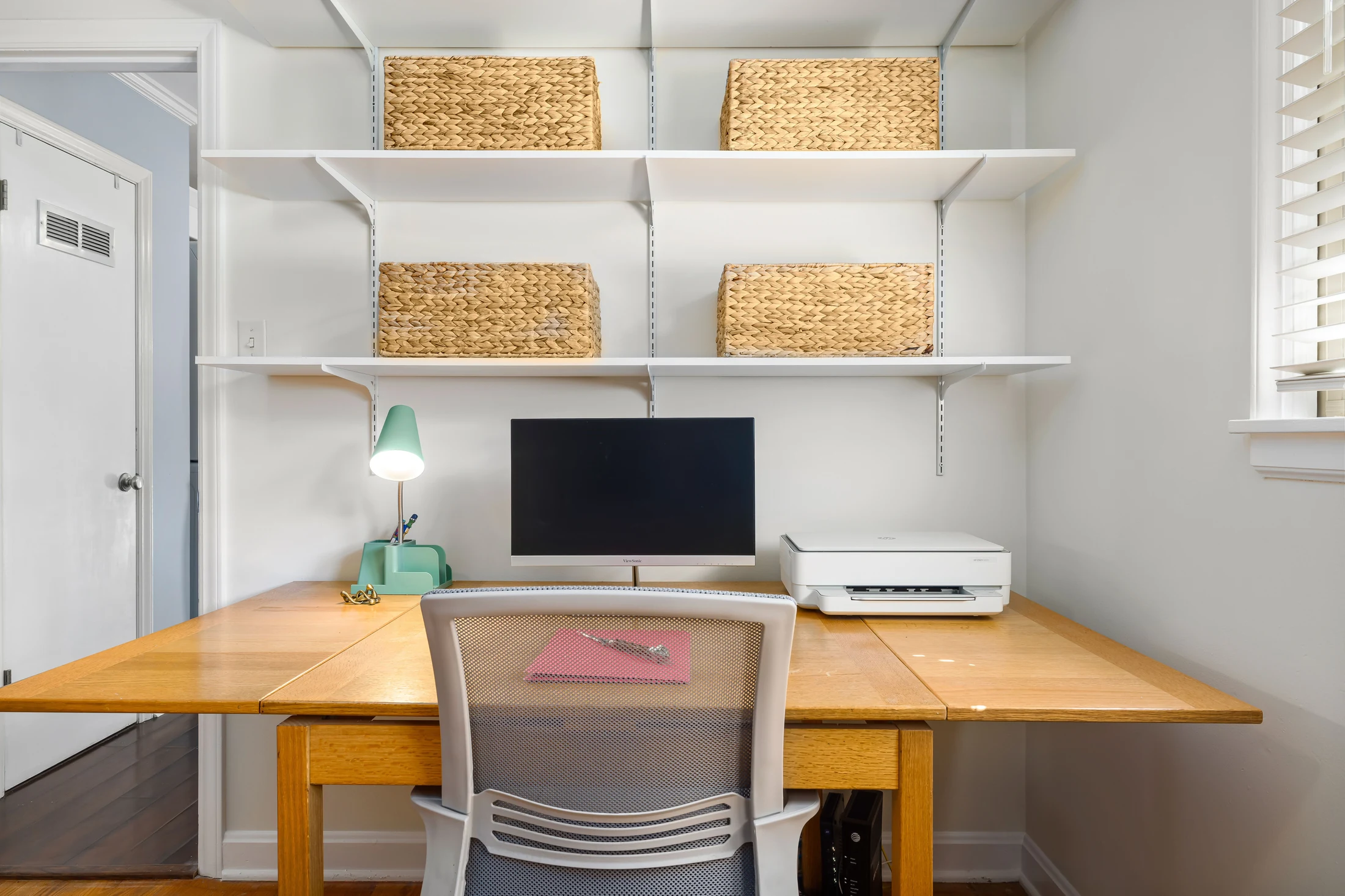
In a dedicated office, the easiest way to make the room feel calmer is often to decide where the practical equipment belongs. Here, white shelves rise above a long wood desk. Woven baskets sit up high, a monitor holds the center, and a printer sits just to its right. Everything has a common address instead of spilling into separate cabinets around the room.
This is the route I would favor for a room that handles both computer work and household paperwork. Put the things you reach for daily at desk level; reserve the upper shelves for lighter, less frequently used items. A few woven baskets give the room a quieter outline without requiring an entire wall of closed cabinetry. If your main challenge is sorting cables, drawers, or individual paper categories, the more specific fix belongs in a desk-organization plan, not in a new shelving wall.
Before copying the arrangement, look at what needs a power outlet, what should be behind a door, and what you can safely lift down. Heavy storage needs an appropriate wall fixing and a load-bearing plan. The photograph shows a useful composition, not an installation specification.
Let open shelves display—and edit—what matters
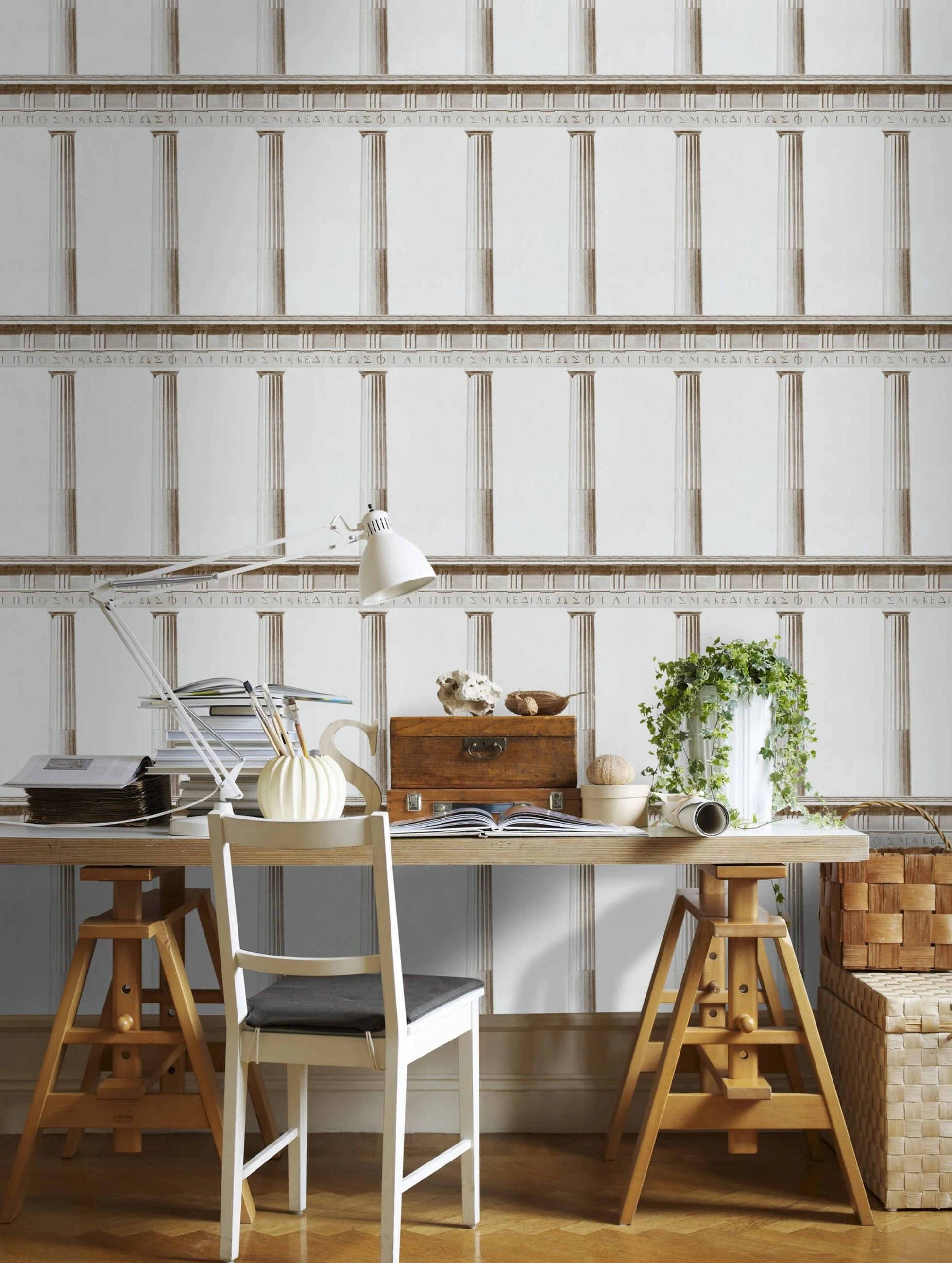
The shelves in this pale office do not form a heavy storage block. Their repeated open lines sit above a slender work surface, with a few objects and plants interrupting the rhythm. Even with an interesting wallpaper behind them, the overall effect stays light.
This is the better choice when you want books, reference materials, or a small collection to contribute to the look of the room. Keep the shelf arrangement loose enough that the wall remains visible; mix upright books with a few lower objects and leave deliberate empty areas. Art can join the composition, but a wall of framed prints is not necessary when the shelves already create a pattern of their own.
There is a tradeoff. Open shelves ask you to look at their contents every day, and they need dusting. If you handle confidential papers or large volumes of loose material, add closed storage elsewhere rather than treating display as a filing system. Compare this room with the earlier storage-wall idea: there, the priority is equipment and access; here, it is the shape of the room.
Leave room for a second kind of sitting
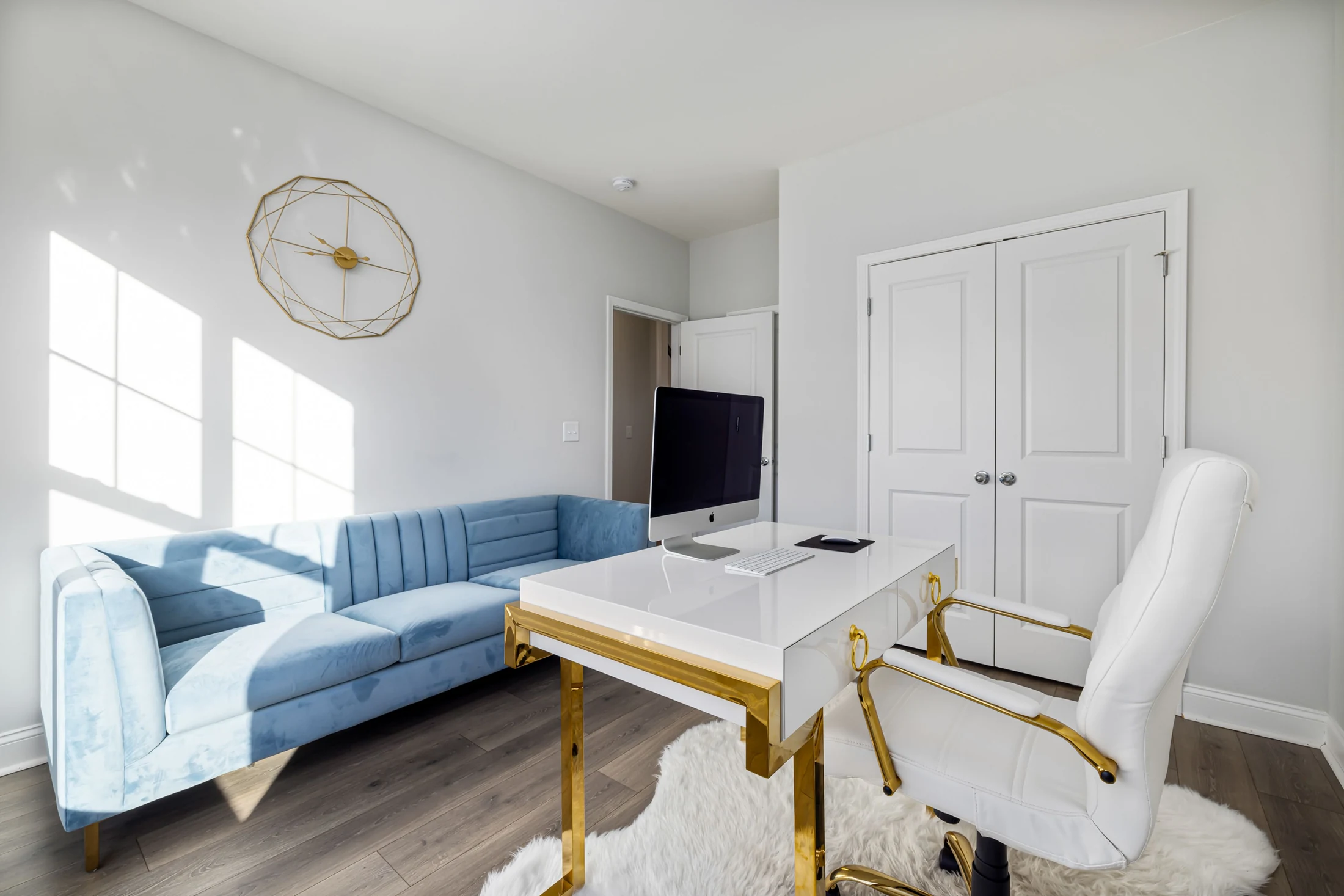
A pale blue sofa changes this white office more than another desk accessory would. The work chair faces the desk, while the sofa makes a separate place to sit without a screen directly in front of you. The room reads as somewhere to spend time, not merely a station to occupy until the day's last call.
A second seat earns its floor space when the office also hosts reading, planning, reviewing documents, or an occasional conversation. For a dedicated office, I would choose an upholstered chair or small sofa before buying more decorative storage. It gives the room another use, and the different fabric adds a softer surface beside the desk's straight lines.
Keep the ordinary path from the door to the desk open. If the additional seat forces you to sidestep furniture, size down to a lounge chair or leave the floor clear. A narrow shared-room office may benefit more from one excellent work chair and an inviting seat elsewhere in the house.
Let a slim white desk keep a bright room open
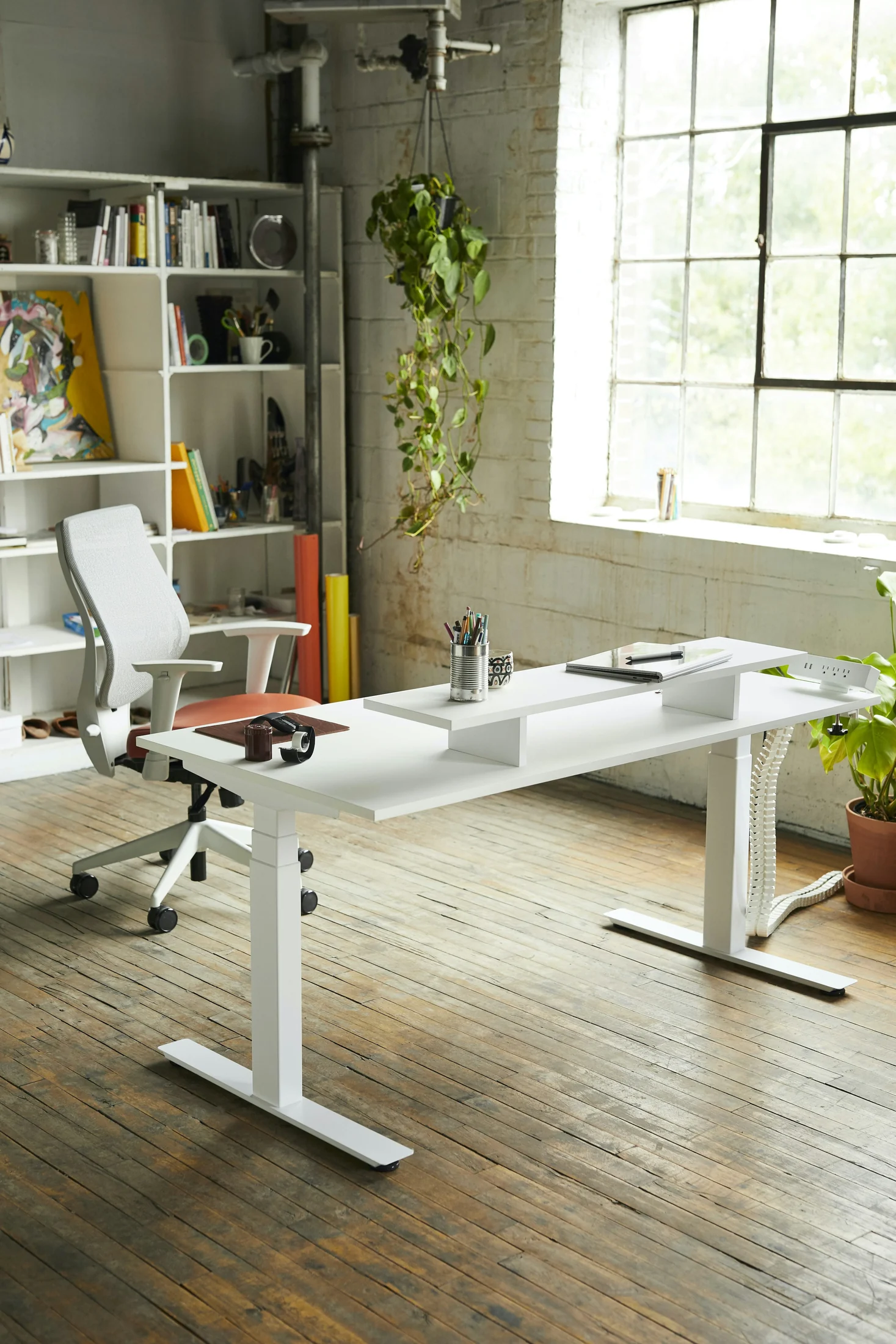
This corner is mostly air. A slim white desk on thin legs sits by a tall gridded window, with a rolling chair, shelves, and a few plants around it. Because you can see the floor under and around the desk, the workstation never reads as a block of furniture, even with plenty going on in the room.
That makes it a good approach for a small room, a spare bedroom, or a loft corner where a bulky desk would shrink the space. Pale tones and exposed legs let light travel across the floor. Keep the surroundings in the same spirit: open shelving rather than a floor-to-ceiling cabinet, and a chair that rolls freely.
A rug is optional here. If you add one over a hard floor, size it to the chair's full working range rather than to the desk alone, and choose a flat, supportive surface over thick pile. Check the edge and any needed grip before calling the setup finished. A rug can also mark out a work zone in an open living area, though this photograph does not show one.
Mix a familiar writing desk with art and everyday tools
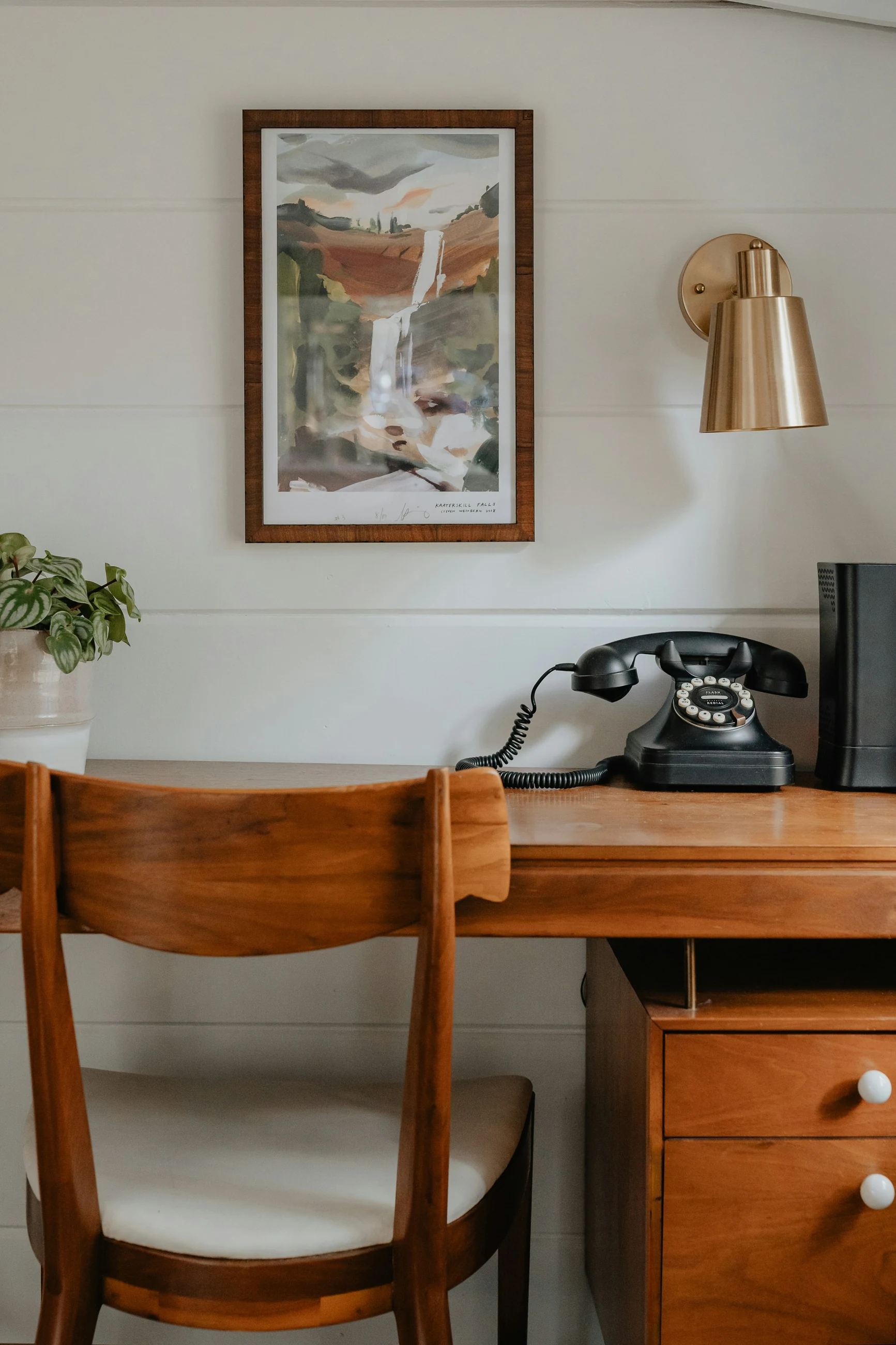
In this quiet corner, a wood writing desk holds a black rotary telephone, with a brass wall light and a framed print above it. The chair is wood with a cream seat, the pieces look collected rather than matched, and nothing reads as an office-supply set. That relaxed mixture gives the room continuity with the rest of the home.
A furniture-like desk is especially appealing in a guest room or an established living space where a conventional workstation would interrupt the decorating scheme. Hang art at a scale that works from across the room, not just as a video-call backdrop. One carefully chosen print can be enough; if you prefer a small gallery wall, organize it as a group around the furniture rather than chasing symmetry with the computer screen.
Function still decides whether this is the right desk for you. A compact writing table may be excellent for a laptop and papers, yet poorly suited to several monitors or a complex equipment setup. Look first at the actual surface and access to power. Let the art and light give the working corner its residential feel.
Give a wood desk a wall with texture
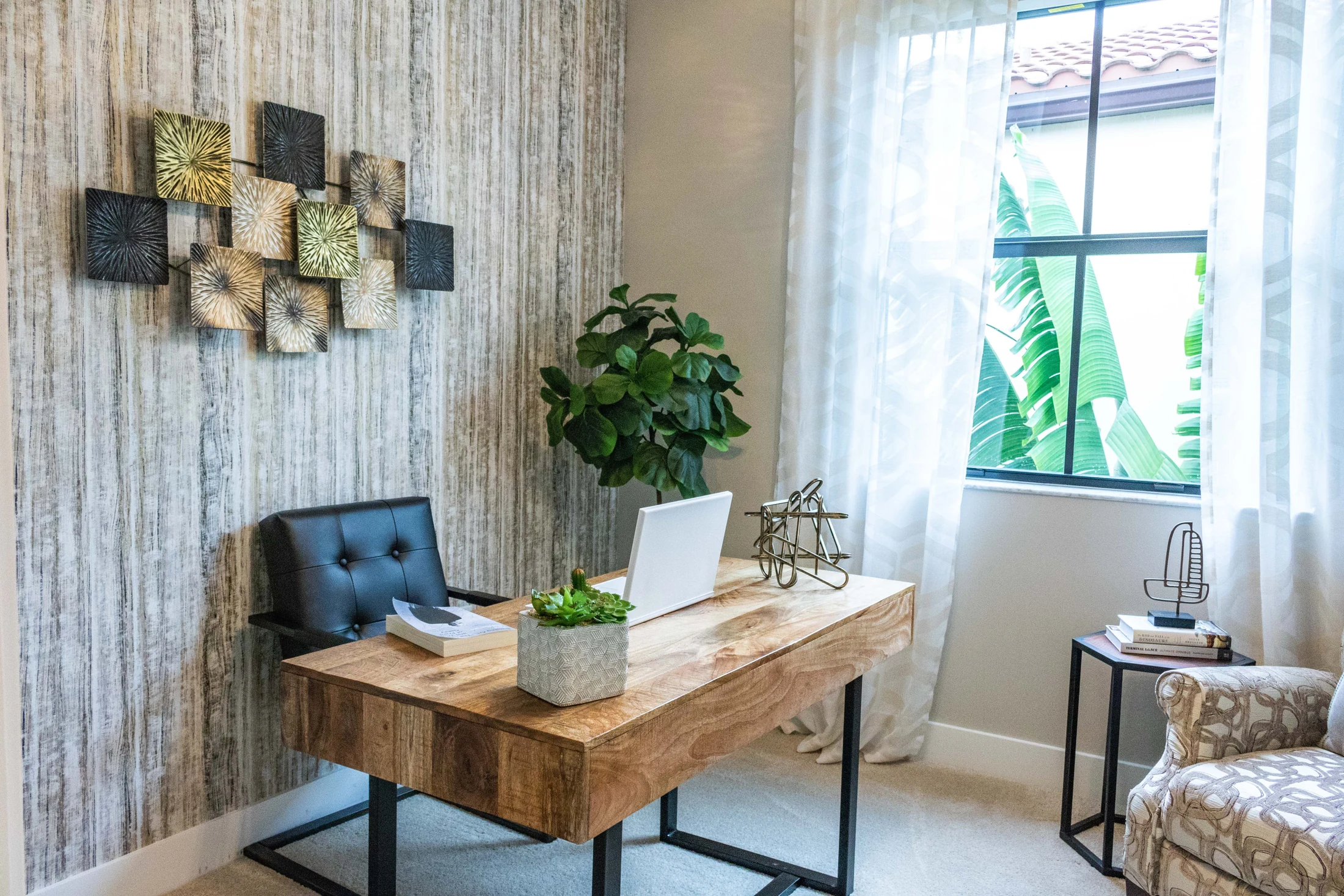
A warm wood desktop, a dark tufted chair, and a streaky gray textured wall make this compact office feel settled. A cluster of metal wall art adds shine to the wall, while daylight and sheer window panels keep the corner from feeling dense. Rather than ordering a matched set of office furniture, the arrangement relies on a relationship between familiar surfaces.
The idea travels easily: pick one material-rich backdrop and let the desk connect to it. Warm wood sits well beside a stone-like pattern, a soft plaster finish, or a restrained woven covering, as long as the tones relate.
For daily work, keep the area immediately around the screen quieter than the accent wall. If you add a highly active wallpaper, busy upholstery, and a patterned rug all at once, the effect can become restless. Start with the wall and wood; add the other layers only if the room still needs them.
Frame a work nook with stripes and painted trim
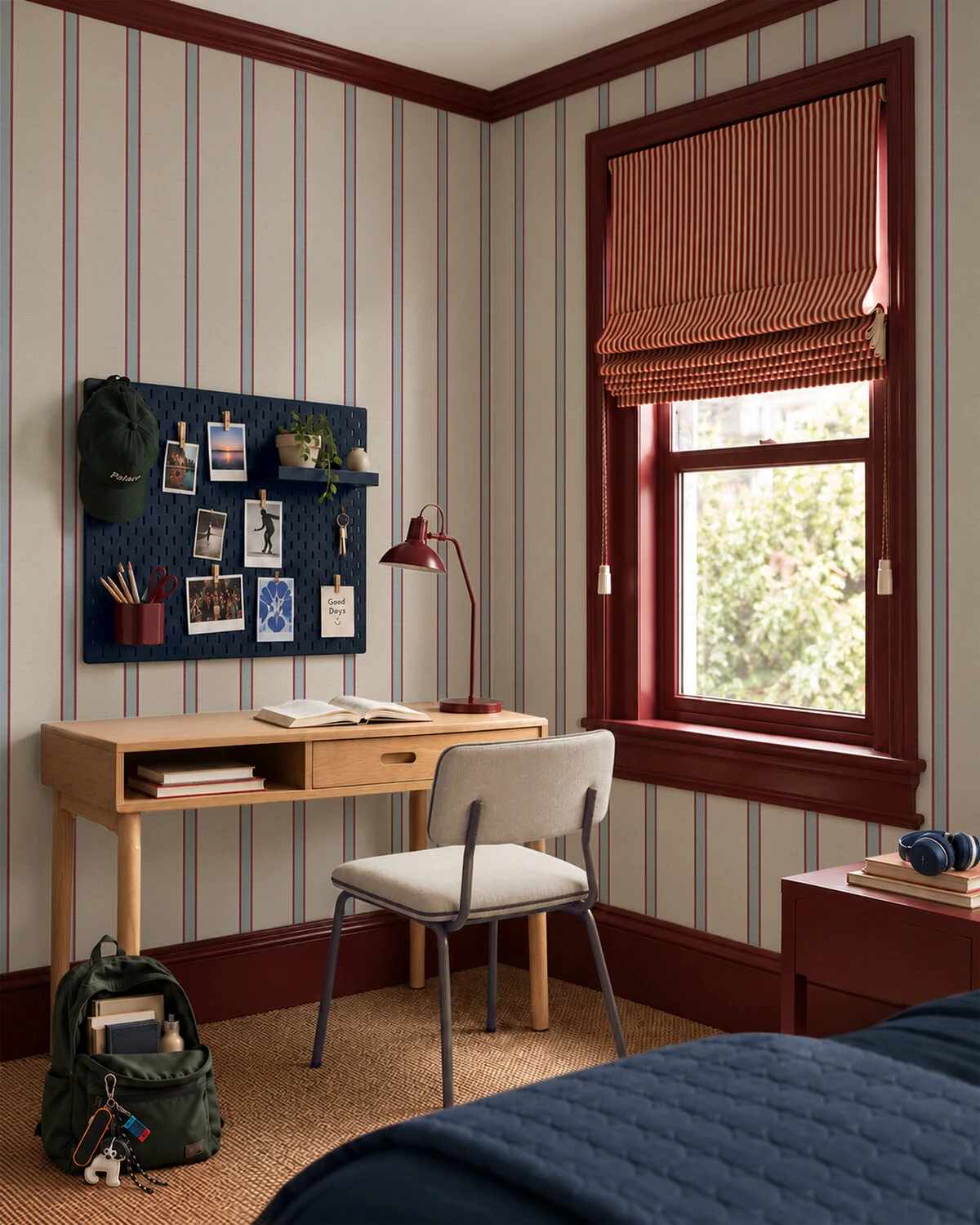
Narrow vertical stripes and wine-colored trim give this corner a clear boundary. In Photowall's room image, the burgundy window framing repeats the dark lines in the wallpaper; a pale wood desktop stays in the background. What might have been an awkward side wall now looks deliberately connected to the room's architecture.
Stripes are particularly effective when you want structure rather than a picture on the wall. Carry one of their colors onto a nearby door frame, shelf edge, or window trim, and the office becomes a coordinated composition with surprisingly little furniture. A restrained chair and simple desk allow that architectural move to remain the focus.
For a renter, removable finishes may be more realistic than repainting trim, but check what your lease and the actual wall surface allow. In a shared room, consider the view from the doorway: the stripes should mark the work zone without visually cutting the whole room in half.
Choose a playful pattern and keep the furniture quiet
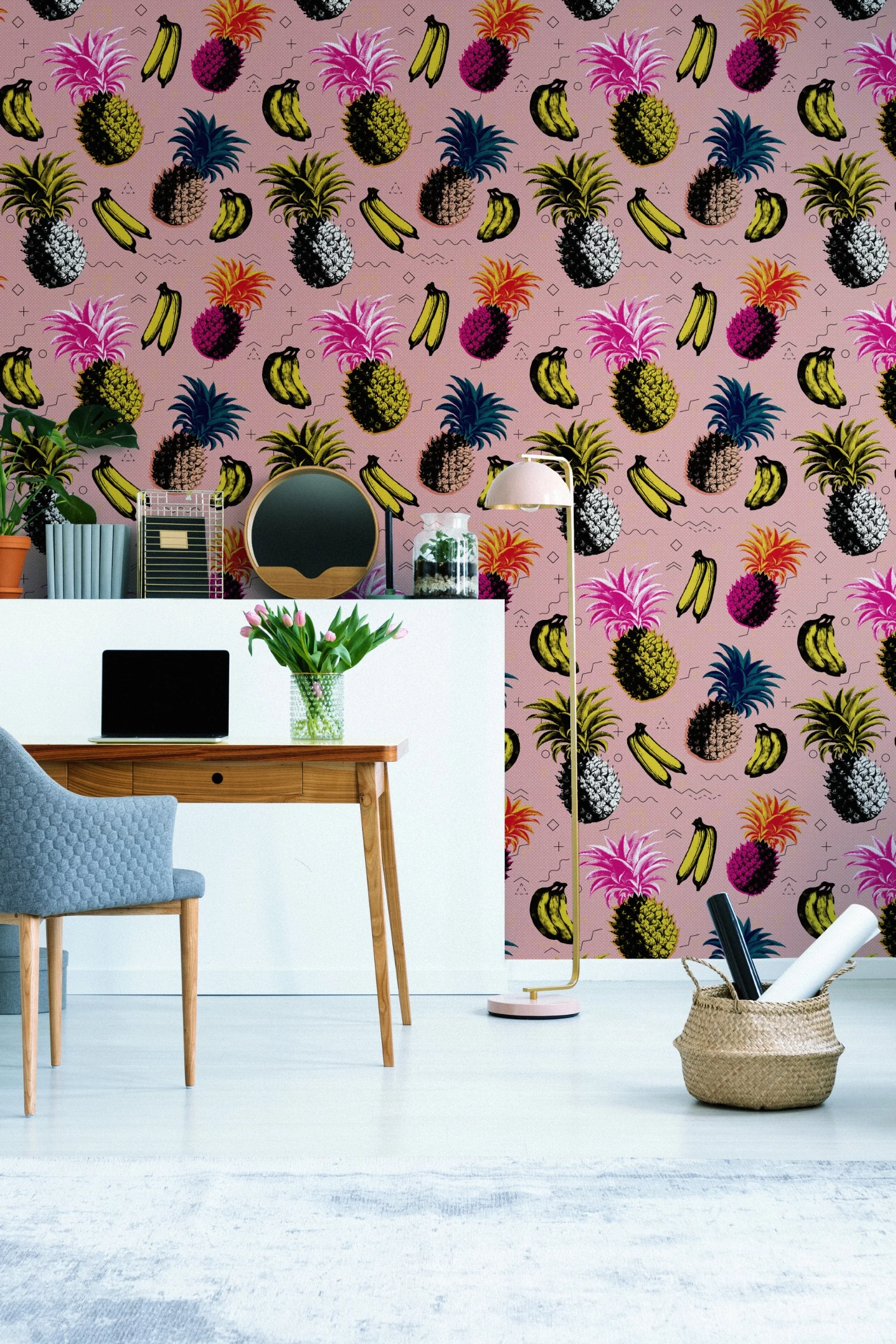
This MINDTHEGAP office puts the personality on the wall. Fruit motifs in pink, yellow, and deeper tones create an exuberant backdrop; the white desk and light blue seating are almost deliberately understated. The pattern carries the room, so there is no need for a parade of colorful accessories on the work surface.
I would use this approach for a creative studio or a personal office that feels too anonymous. Choose one dominant wallpaper, then pick two colors from it for smaller repeats—a chair, a lamp, or a textile. Let the desk and larger storage pieces stay comparatively calm. This is a different decision from the stripes-and-trim treatment: here the wall is the expressive object, not an architectural outline.
Stand at the actual desk position before committing. A lively wall behind the monitor may be delightful from the doorway but visually exhausting during focused screen work; it may also read as a busy backdrop on video calls. A side wall can deliver the same energy while leaving a quieter view ahead.
Build a traditional study from a few collected pieces
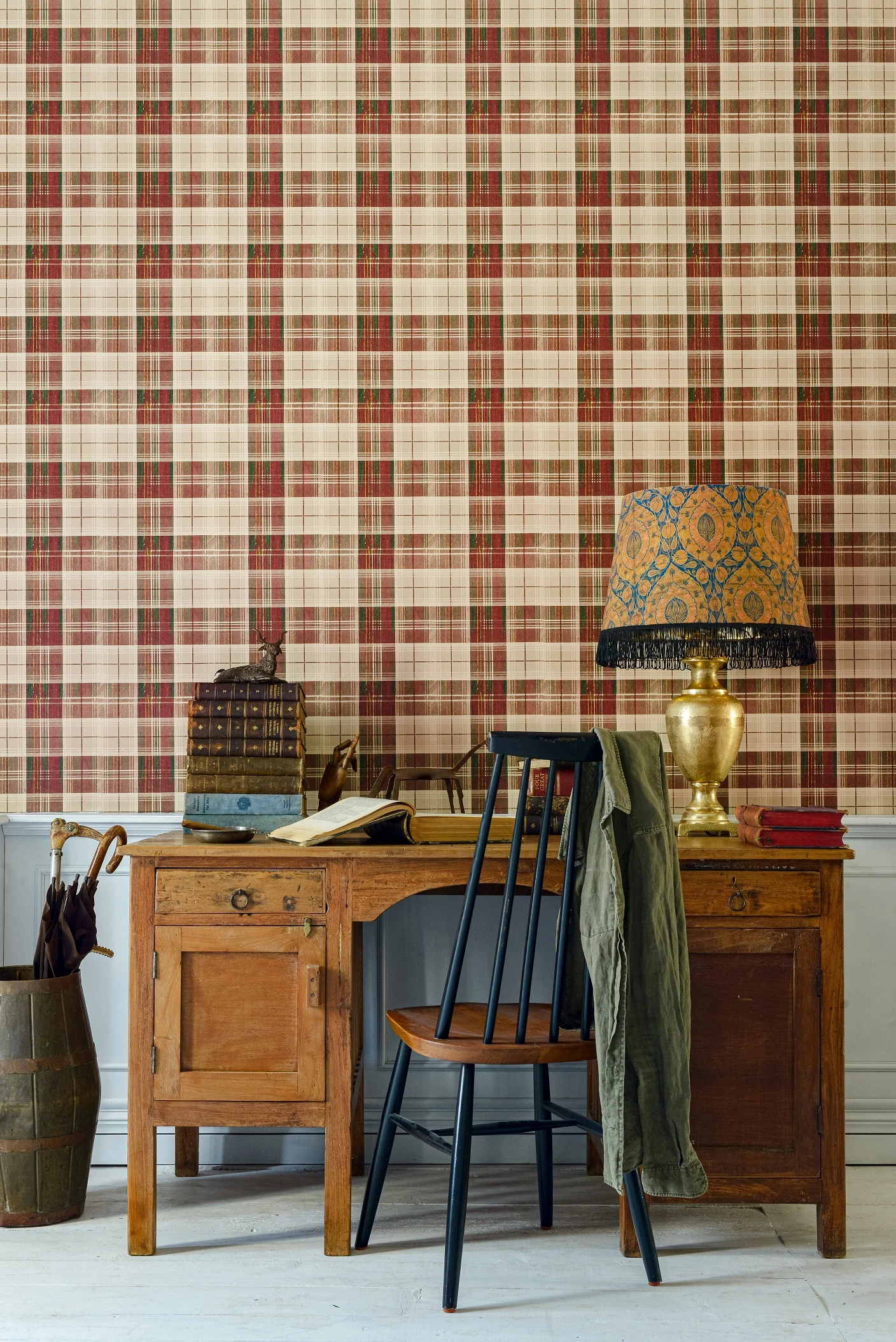
Plaid wallpaper, a wood desk with drawers, a deep blue chair, and a patterned shade give this room the mood of a traditional study. The pieces are not identical, but they share an earthy warmth. That is why the scheme feels collected rather than like a coordinated corporate office suite.
If you prefer country or classic interiors, begin with one strong patterned surface and a worktable that looks like household furniture. Repeat one warm note in the lamp, a chair textile, or a frame. Avoid filling every shelf with themed objects: a practical stack of books and a good lamp will say more than decorative props that must be moved for real work.
Test the room's lighting against the depth of color you choose. Dense plaid, shaded corners, and an older-looking desk can be appealing together, but paperwork and a screen still need a usable visual field.
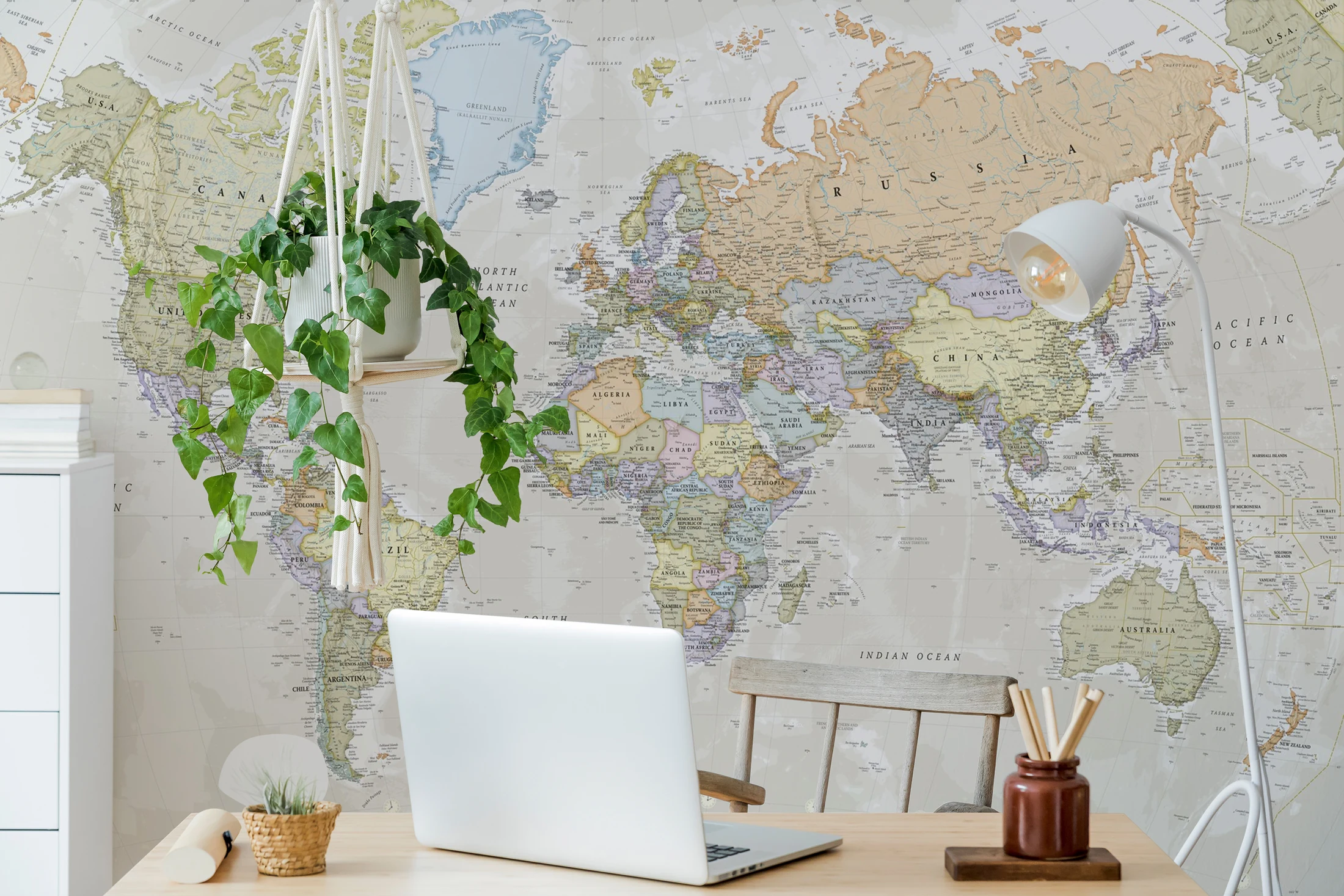
Let a mural carry the whole desk wall
A vintage-style world map fills the wall behind the white desk in this Wallsauce image. The laptop, lamp, and plant are modest beside it, which is exactly why the composition works. The mural gives the room a focal point without asking the desk or chair to be unusual.
For a plain spare room, a large image can be more effective than assembling many small accessories. Choose a subject you want to live with—cartography, landscape, architecture, or an abstract drawing—then leave room around the desk for the artwork to be legible. A mural's scale matters: the best subject is one that still makes sense behind the actual furniture, not just in a product photograph.
Before choosing the image, mark the wall areas interrupted by the window, shelves, and computer screen. Check how the essential part of the motif will sit in that space. Printed-wall products come with their own sizing and installation requirements, so read them before you commit.
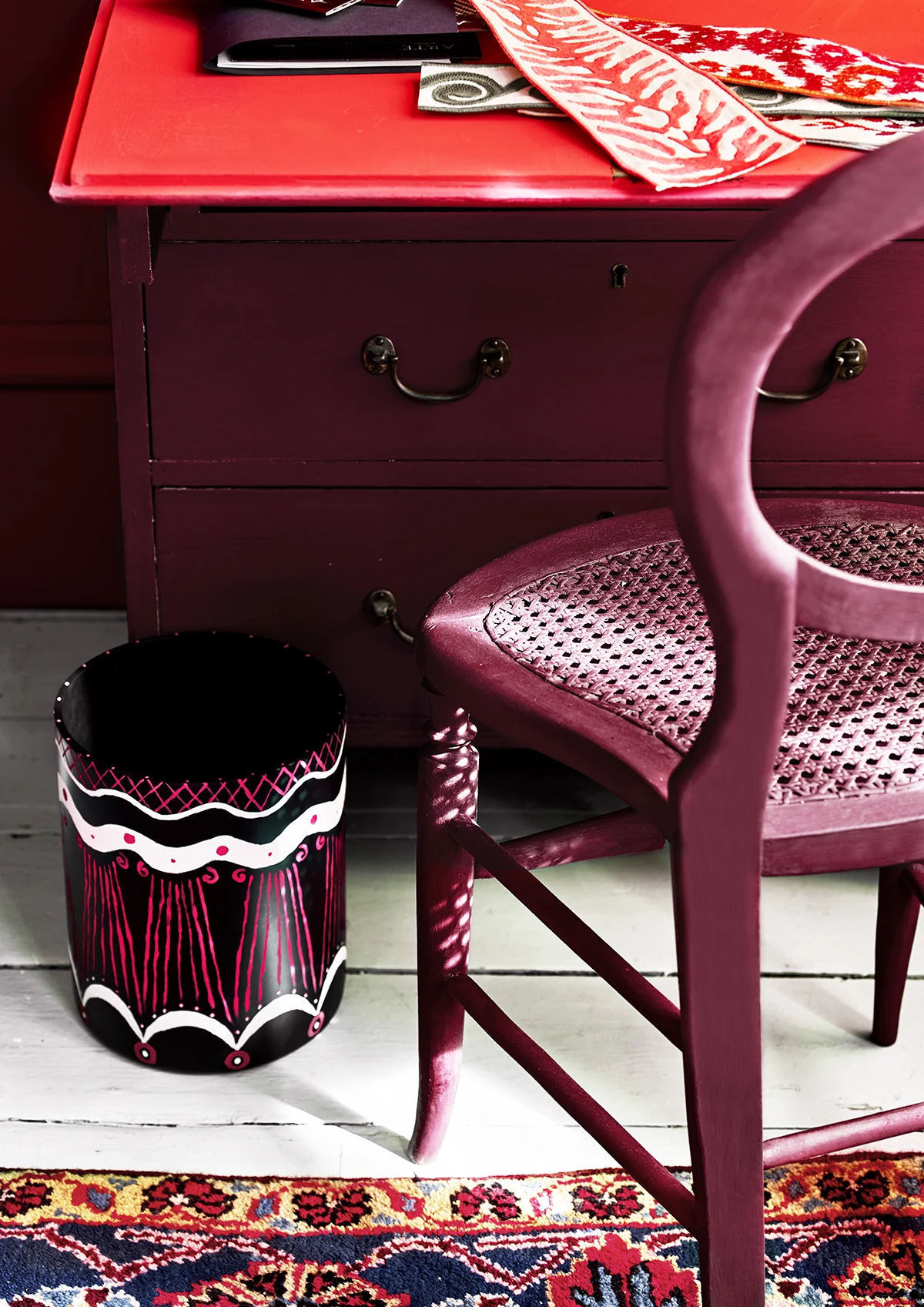
Paint one piece when a whole statement wall is too much
The burgundy drawer unit and pink-toned chair in this Annie Sloan detail show how much personality one small piece can carry. The patterned textile provides another color note, but the painted furniture remains the clear focus. You can read the scheme without seeing an entire room.
If a vivid wallpaper or mural feels like too much commitment, I would start with a drawer unit, small cabinet, or chair frame. Put the saturated shade on one object, then repeat a related color in a textile or artwork. This approach suits a room that must still feel quiet around the desk, and it is easier to reconsider than a whole wall of strong pattern.
Do not rely on a product photograph to guarantee an exact color match on your walls or furniture. Test the finish and shade on the actual surface under your room's lighting, following the selected product's directions.
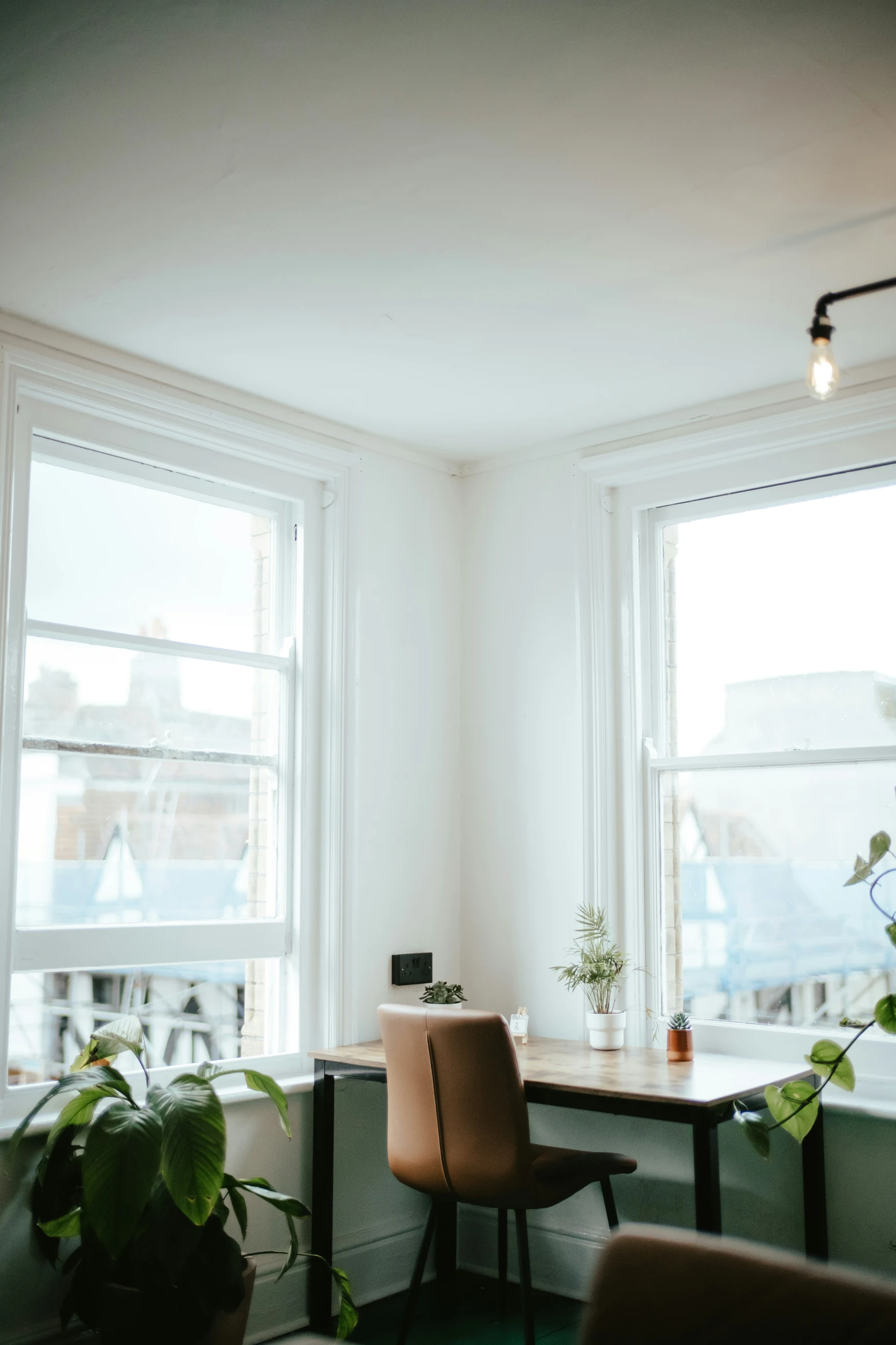
Use plants to soften a bright office corner
This office corner has large windows, a modest wood desk, and green plants at several heights. A tall leafy shape near the window and smaller pots closer to the desk interrupt the straight lines of the furniture. The result feels occupied and domestic without becoming crowded.
If your work area is mostly hard surfaces, one larger plant plus a smaller one may do more than several miniature decorative objects. Place them where the foliage will remain visible from the room and where you can still open the window, move the chair, and reach the desk. Varying height matters more visually than filling every inch of the sill.
Choose plants for your actual light and maintenance routine, not from a guessed species in a photograph. Greenery is a decorating decision here, not a promise of cleaner air or higher productivity. In a room with little daylight, a well-chosen artwork or textile may be a more convincing softening layer than forcing live plants into unsuitable conditions.