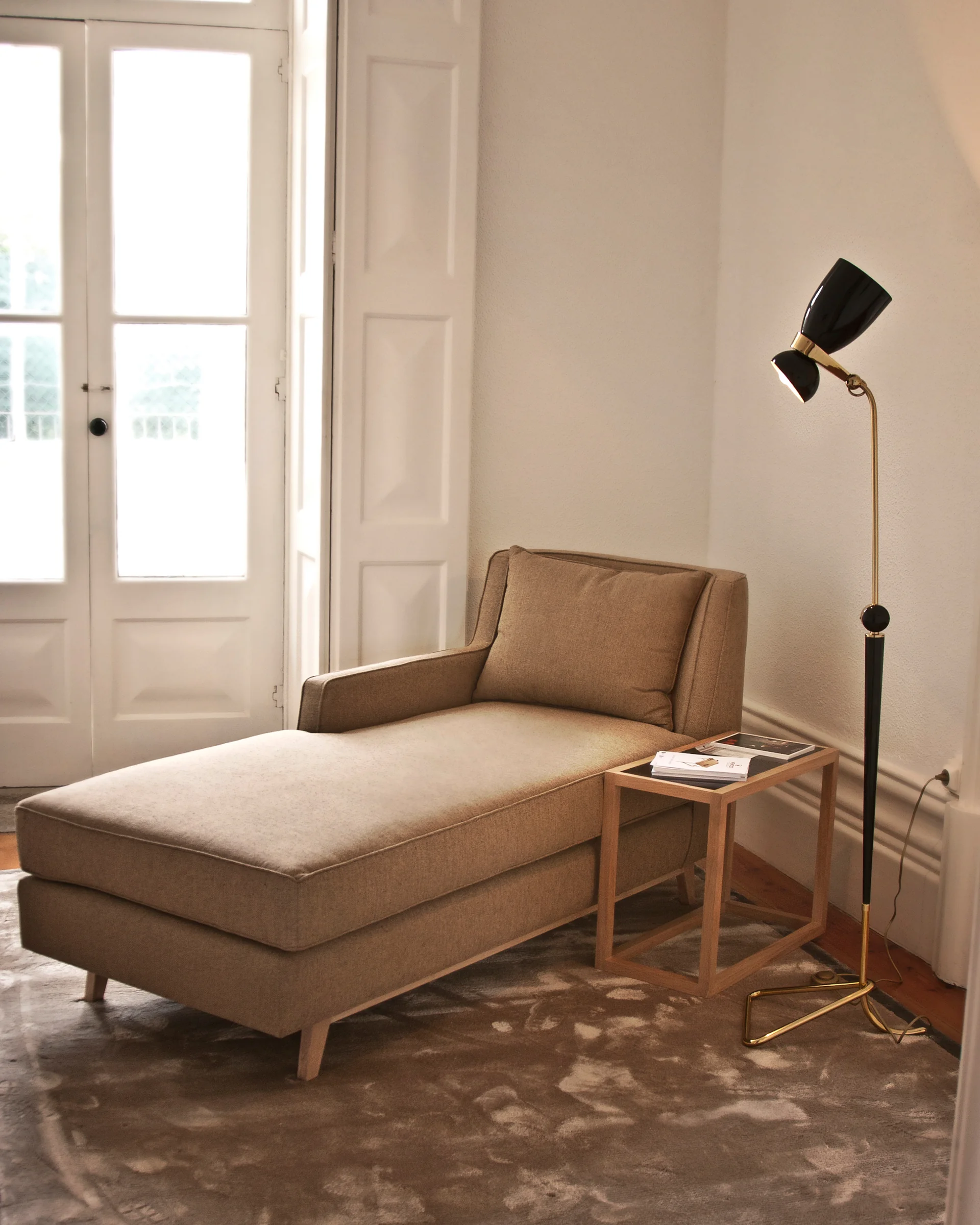
Choose a Slim Directional Lamp for the Chair You Actually Use
A reading corner rarely needs an enormous studio tripod. Here, a black-and-brass floor lamp stands just past a beige chaise, with a narrow stem and a small angled head. The wooden side table beside the chaise stays free for a book. The lamp is present, but the chair still defines the corner.
This is the first shape to try when one person uses the same seat regularly, especially in a smaller living room or a flexible home office. Before choosing, sit in the chair as you normally would and check where the cord and control would land. DelightFULL describes the pictured Amy floor lamp as having a flexible shade and a footswitch on its cord. Those details make it worth considering for a reading seat, but confirm the exact version’s beam and range before ordering; the photograph cannot measure either.
The real advantage is placement: a slim stand lets the beam sit closer to the job without a big base reaching across the walking route. Compared with the much broader tripod in the next idea, this is the quieter, more targeted choice.
Give a Tripod Spotlight a Corner of Its Own
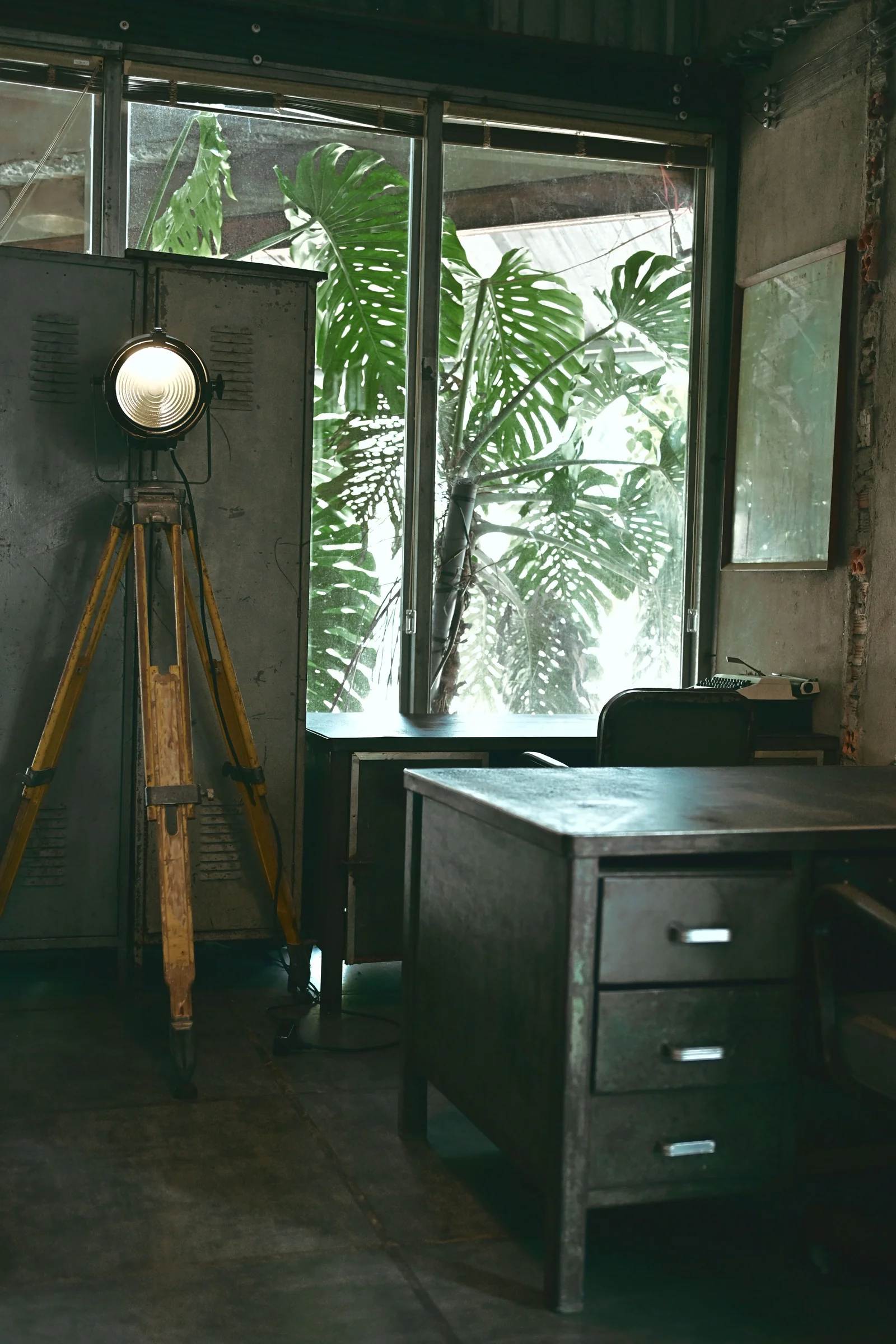
An industrial tripod spotlight is closer to a small piece of equipment than a discreet floor lamp. In this workroom, a round metal reflector sits on three spread wooden legs beside a steel desk and a tall window. The legs splay across the floor, and that footprint is part of the look, not a detail you can hide behind the sofa.
Choose this form where there is a genuinely free corner, perhaps beside a bookcase or against a rough-textured wall, and where the legs won’t cut across the route to a chair. Aged wood, dark metal, and exposed hardware give plain plaster or timber a useful counterpoint. In a tightly furnished corner, however, the same structure can look accidental, with one foot trapped under furniture and another sticking into the room.
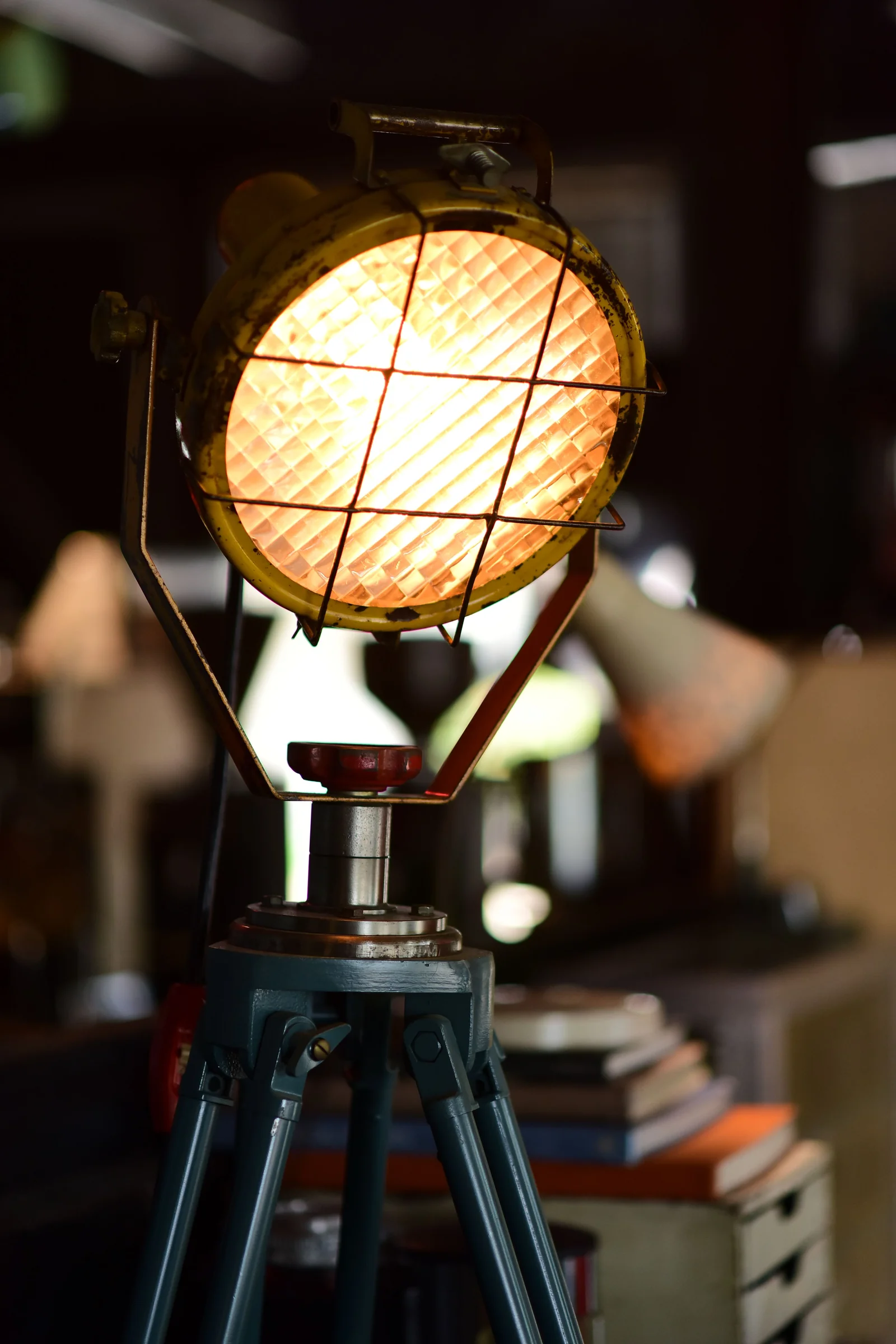
A second photo shows a different, larger caged spotlight on a dark metal tripod, switched on. It makes the glare problem easy to see: the brightest thing in the frame is the source itself, and a seated guest would meet it head-on if the lamp sits near eye level. This kind of image doesn’t show whether the pictured unit is certified for residential use. When buying a vintage-looking spotlight, distinguish a lamp manufactured for household use from salvaged studio equipment with unknown electrical condition. Check the product documentation and safety certification rather than assuming that a working bulb makes a conversion safe.
Try a floor-space test: mark the base area of the lamp you are considering (painter’s tape works), then walk the normal route past the sofa or desk. Sit down and look toward the shade from your usual eye level. If you see a hard, bright source or the base forces you to step around it, choose a slimmer task lamp or move the tripod to a genuinely open corner. A theatrical head is not automatically a comfortable reading beam.
Let a Black Studio Shape Stand Against a Light Background
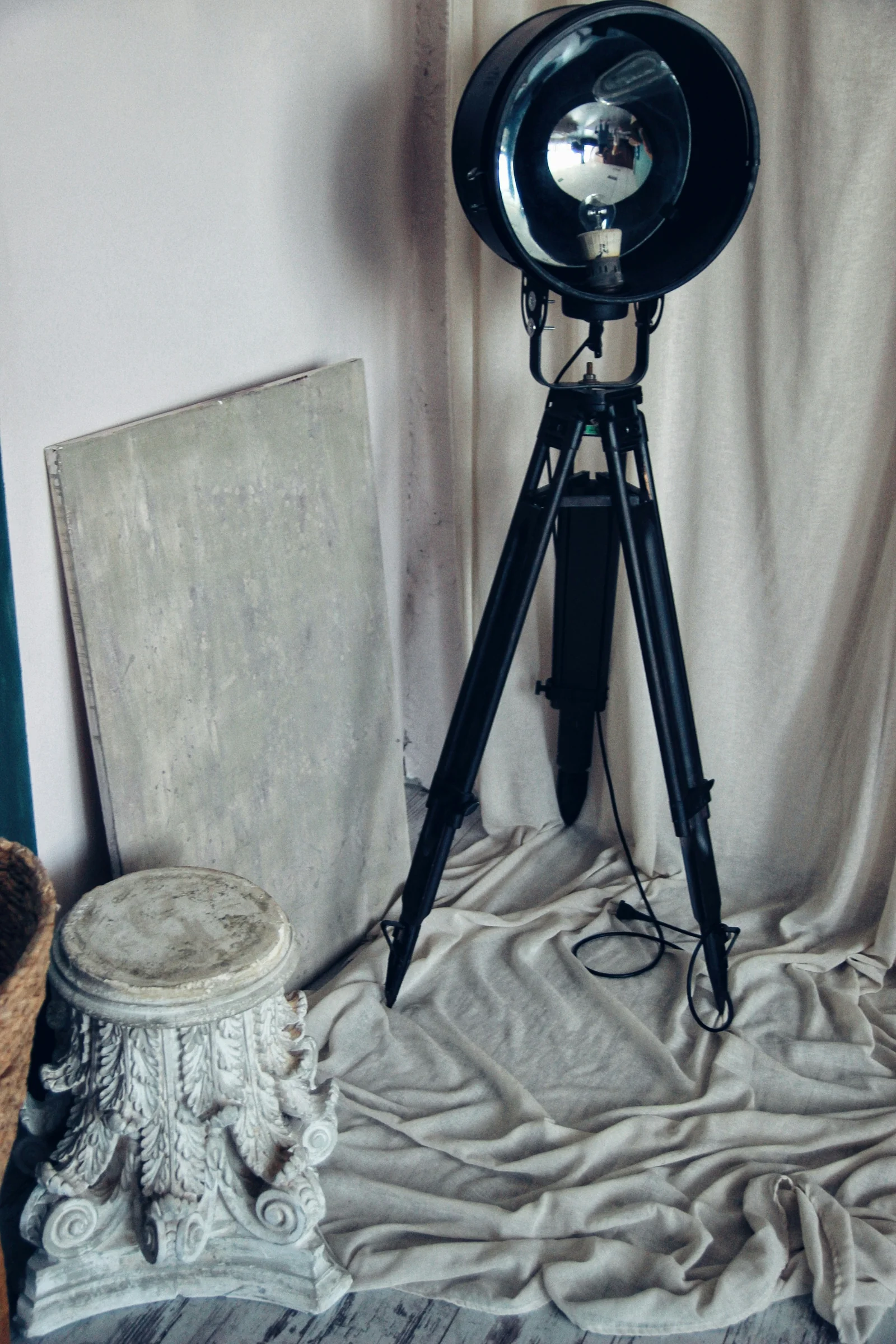
A large black lamp head needs somewhere for its outline to register. In this still life, a round black reflector on slim black legs stands in front of pale, draped fabric. The contrast makes the shape instantly readable, from the dark ring around the lens to the tripod below it.
Use the same principle in a living room with off-white walls, soft curtains, or pale upholstery. The lighter field makes a dark industrial piece feel deliberately chosen, even if the room has little exposed brick or other workshop imagery. You don’t need more black furniture to justify the lamp; repeating the finish once in a picture frame or side-table base is often enough.
This idea differs from the footprint decision in idea 2: here the question is whether the whole silhouette looks right against your materials. In a very dark corner the legs recede while the head dominates; against a brighter wall the lamp reads as a complete object. Before buying, check the actual head diameter and direction, not only the advertised overall height. A styled shot like this is not evidence that the fixture lights a furnished room well.
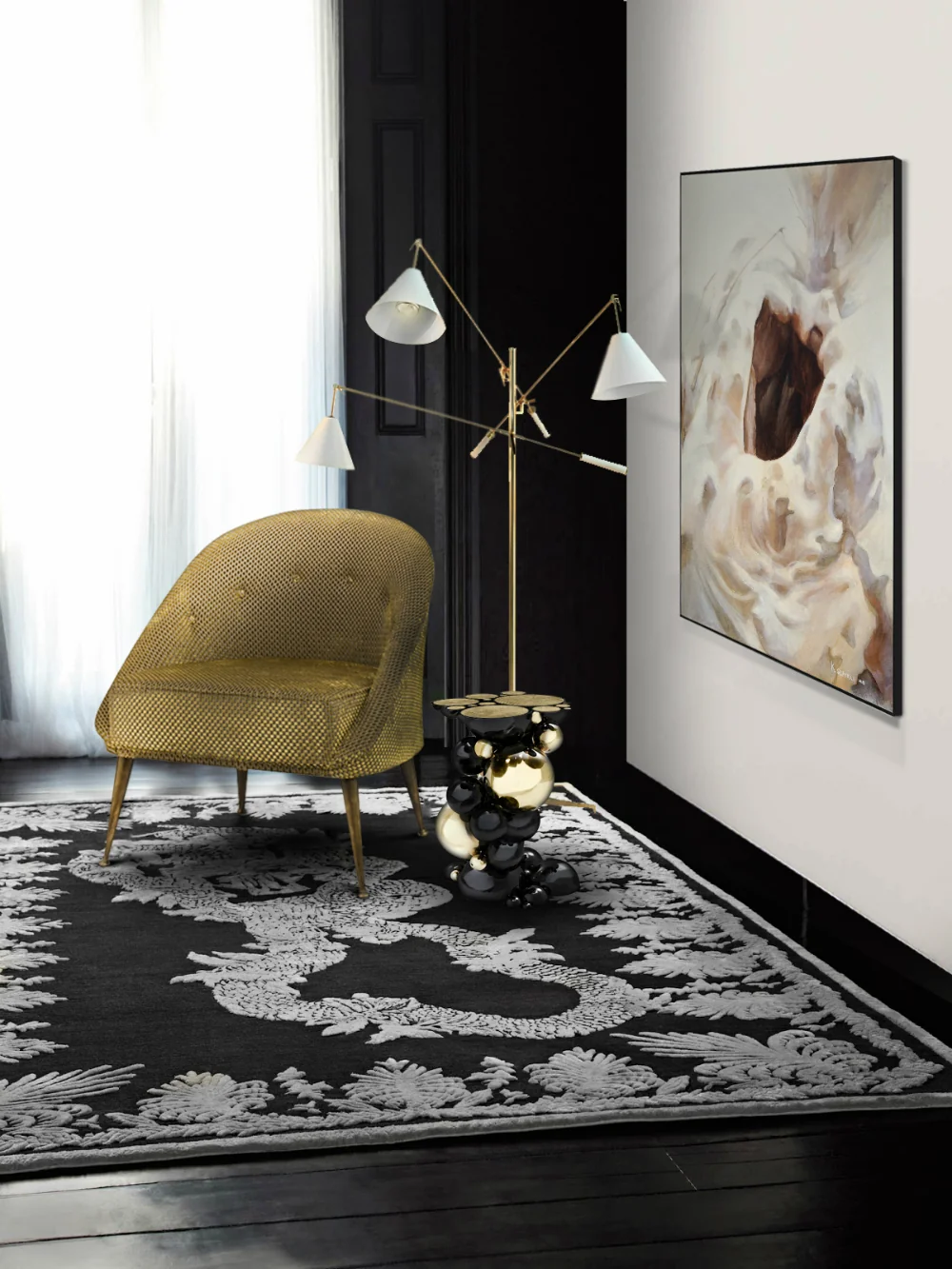
Use Branching Arms to Give a Seating Group a Different Rhythm
The DelightFULL Sinatra floor lamp shows how one central stem can make a broader gesture. Pale cone shades extend on brass-tone arms beside a mustard-colored chair. A bold black-and-white rug and a dark doorway give the slim structure something to stand against, while the spread of the arms gives the corner more reach than a single narrow pole.
This is a compelling option when you want an expressive object near a pair of chairs or a larger sofa rather than a modest light at one reading spot. The branching form moves attention across the seating arrangement, and it can tie together several metal accents in the room without a matching set of fixtures. Place the base where the arms look balanced against the furniture, and check the full span of the actual model before ordering.
DelightFULL describes Sinatra as available with one to three movable arms; this photograph shows a three-shade arrangement. Verify the configuration and controls of the model you order rather than assuming the heads switch independently. A multi-shade fixture replaces separate reading lamps only if it can direct enough light to the occupied seats; if the arms are mainly sculptural, use it for atmosphere and add a dedicated task source. Keep projecting arm ends out of the space where people stand up or pass through.
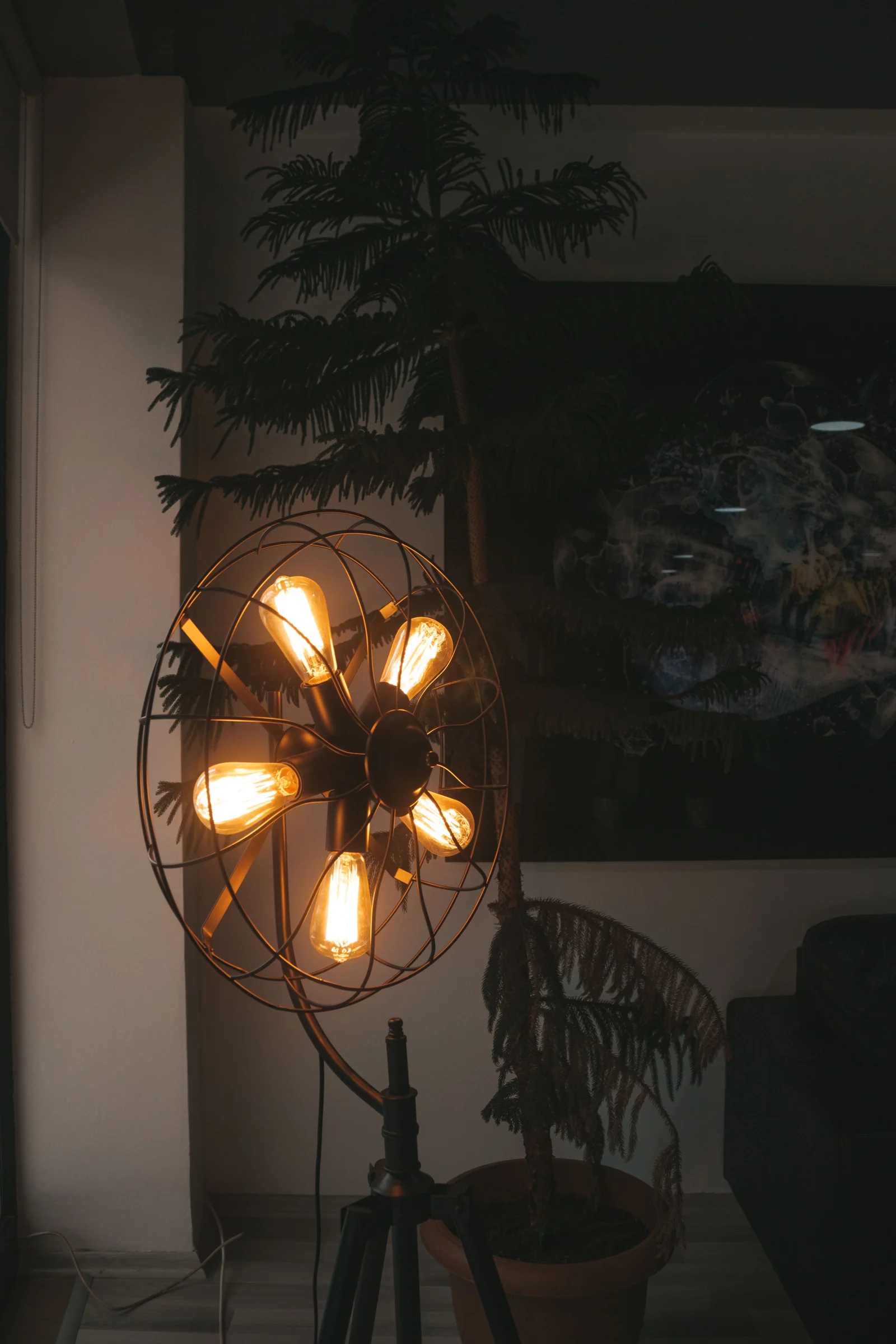
Make a Five-Bulb Fan Head a Statement, Not Five Reading Lamps
In this dark room, five glowing filament bulbs sit inside a circular, fan-like metal cage on a tripod stand. The effect is immediate: a bright industrial emblem rather than a conventional shaded floor lamp. It works best when you want the fixture itself to be the focal point, with a plant, art, or a dark wall giving it context.
Five visible bulbs do not mean five separately aimable task beams; they all sit in the same decorative head. Their direct view can also compete with a television or a conversation area, particularly when the lamp is close to the seated sightline. Before choosing a multi-bulb statement piece, look at it from the sofa rather than only while standing in a showroom.
For a comfortable living room, treat this as an accent within a broader lighting arrangement. Keep a shaded lamp near the reading seat and softer ambient light elsewhere rather than asking the fan-head fixture to solve every need. Check the product label for compatible bulbs, controls, and electrical specifications; a photograph shows where the luminous points sit, not their brightness, color temperature, or safety rating.
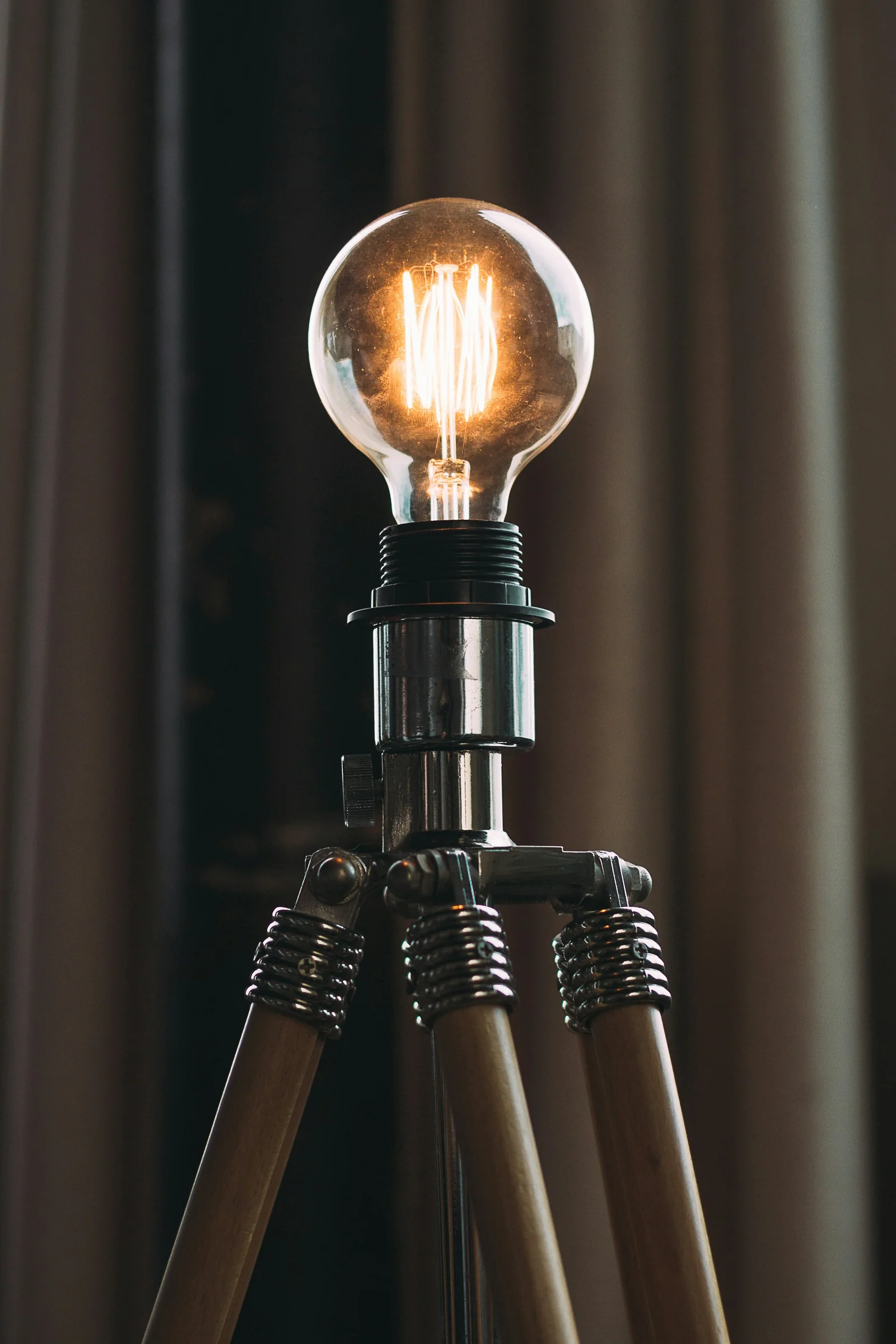
Decide Whether the Bulb or the Shade Should Be the Feature
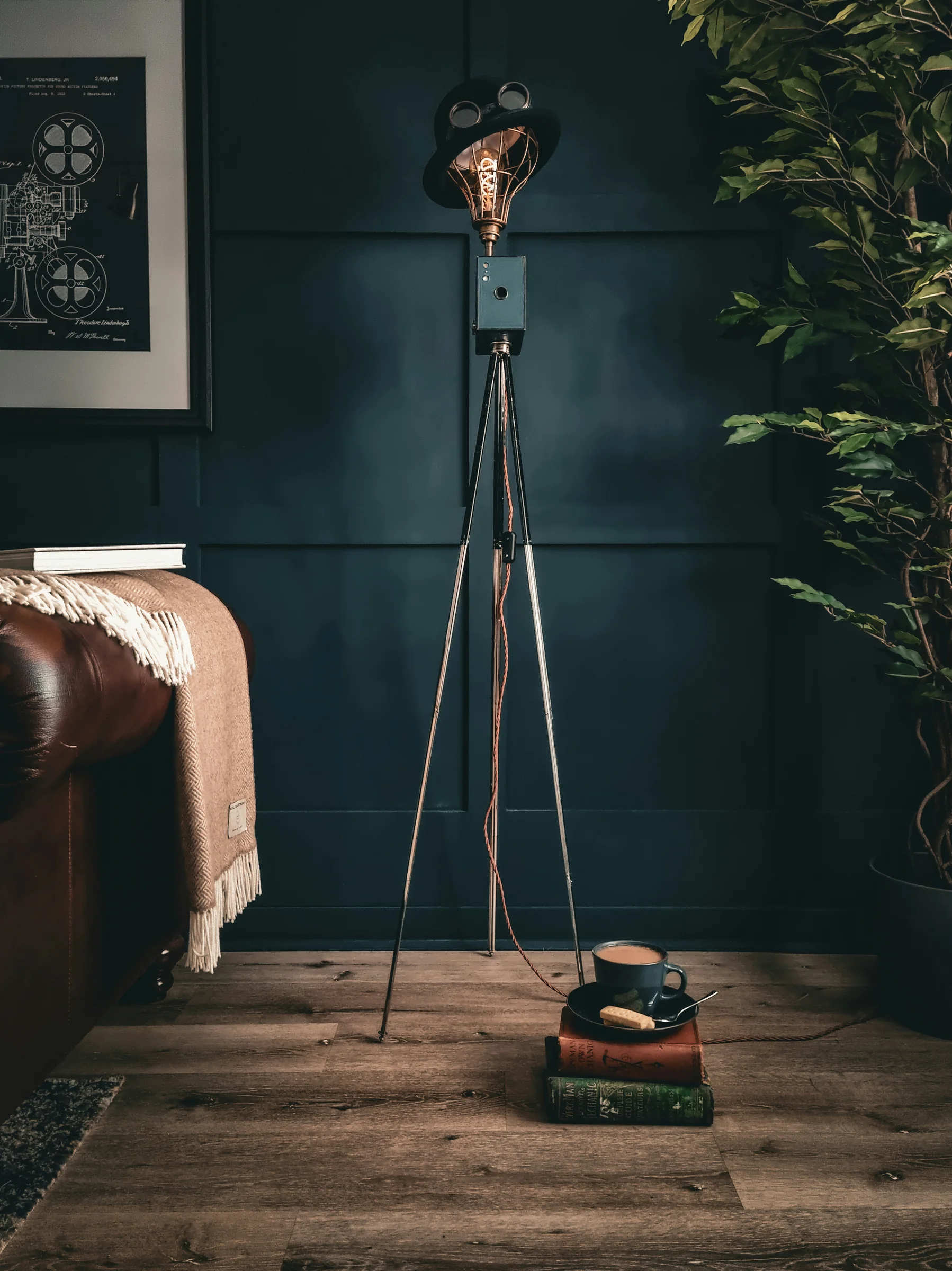
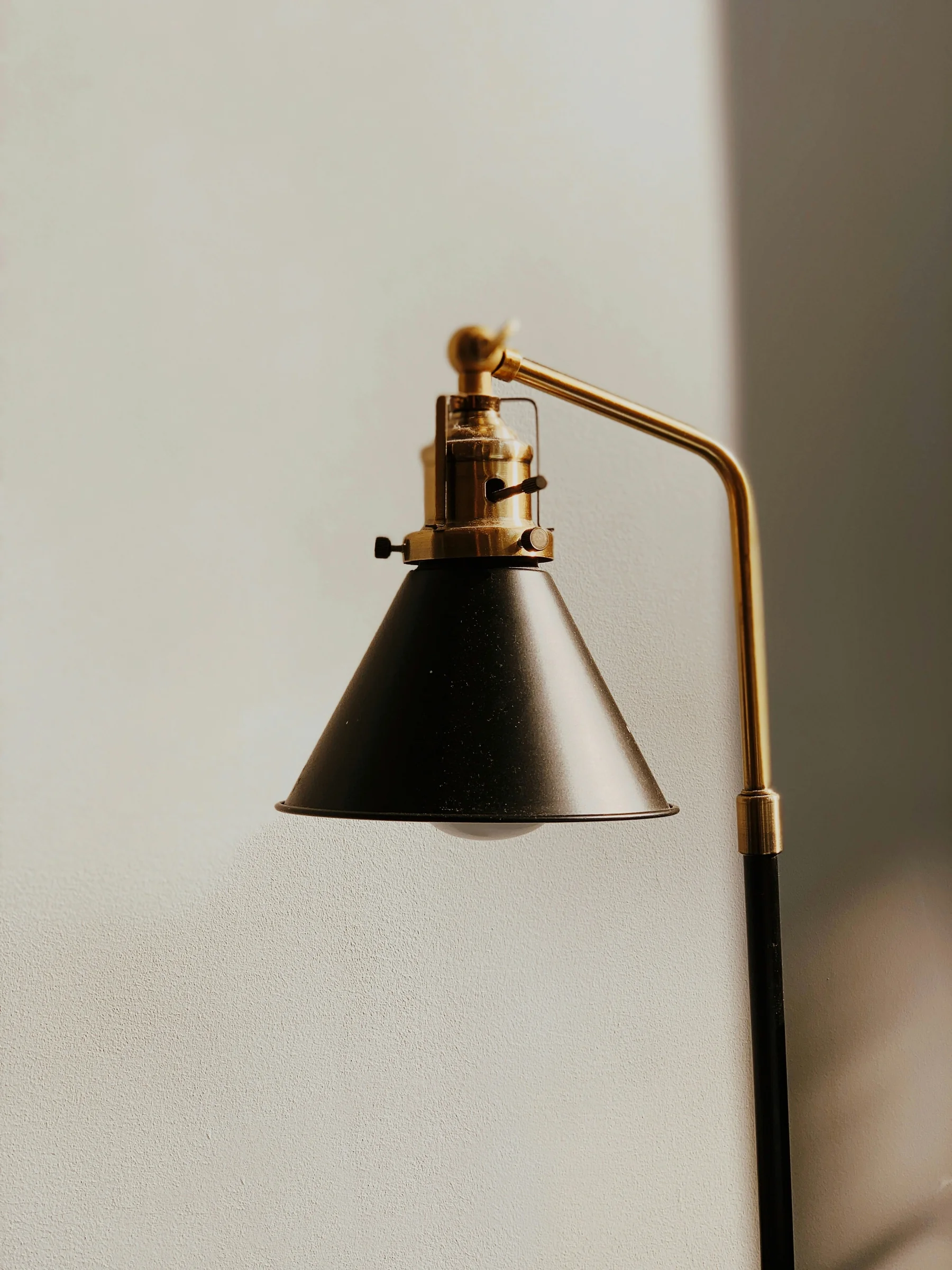
Industrial style does not require every bulb to be visible. The first photo shows a glowing filament bulb in a dark socket on a tripod with wooden legs and metal collars. A matte black cone with a brass-tone fitting draws attention to the shade’s profile, as shown in the comparison below.
A direct-view bulb adds a concentrated point of warmth and an unmistakable workshop reference. It also puts the brightest element in plain sight, which can be distracting beside a frequently used chair. A cone shade emphasizes its profile and can help direct the light, depending on the actual construction and bulb. For the lamp beside a reading chair, choose the shade, and keep the exposed filament for an accent outside the main eye line.
The finish can do more work than novelty details. A restrained black pole with a brass-tone joint sits comfortably beside warm wood, leather, linen, or a pale wall. If the room is already dark, add contrast through nearby upholstery or wall color rather than another heavy black object. Read the bulb label, too: correlated color temperature (CCT) describes how warm or cool the light looks, while color rendering, often shown as CRI, describes how faithfully it shows colors. Neither can be judged from the glow in a photograph. For more on both terms, see the U.S. Department of Energy’s LED Basics.
Choose by the Seat, the Base, and the Beam
A lamp can be a strong design choice and still be wrong for the place you intend to put it. Use the comparison below to narrow the options before looking at finishes. It adds one form not pictured above, a curved arc lamp, because it solves a different placement problem: reaching over furniture from a base set to one side. The Flos Arco is a documented example of that principle, not a specification for every arc lamp.
| Lamp form | Good fit | Check before choosing |
|---|---|---|
| Slim directional (idea 1) | One frequently used chair or tight nook | Shade aim, switch reach, stable base, outlet |
| Tripod spotlight (ideas 2 and 3) | Open corner with visual space for the legs | Measured leg spread, glare, residential electrical suitability |
| Branching multi-head (idea 4) | Shared seating group or an expressive focal point | Exact arm span, head movement, switching, walking route |
| Five-bulb fan head (idea 5) | Decorative focal light with other layers provided | Direct-view glare, screen reflections, bulb compatibility |
| Bulb- or shade-led (idea 6) | Shade beside the reading seat; bare filament as an accent away from the eye line | Bulb label (CCT, color rendering), shade aim, where the bare bulb sits in the sightline |
| Curved arc (not pictured) | Light needs to reach over furniture from a base to one side | Model-specific reach, base size/weight, height and stability |